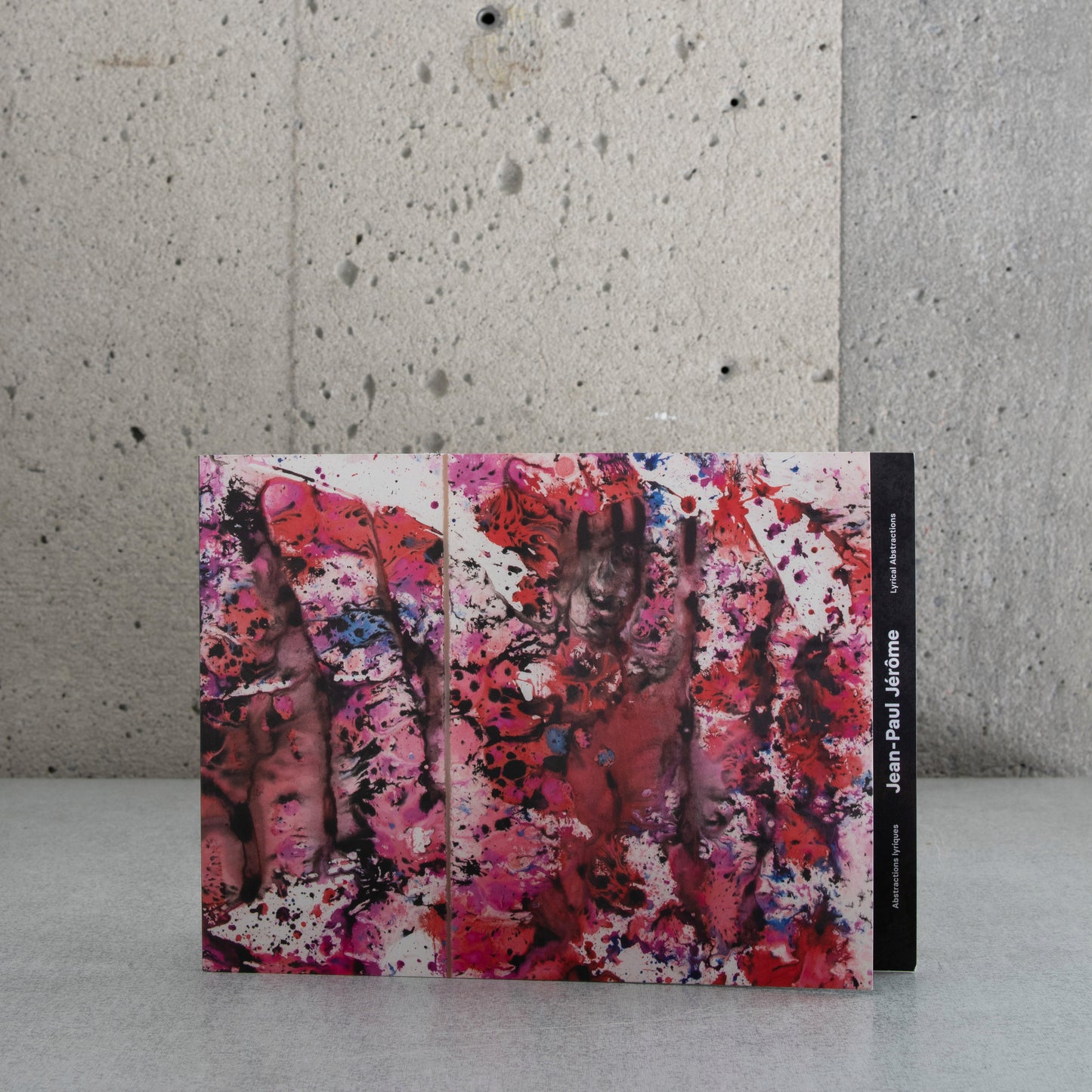
Lyrical Abstractions - Jean-Paul Jérôme
Lyrical Abstractions - Jean-Paul Jérôme
Couldn't load pickup availability
Publication date: January 31, 2020
About the artist and the contents of the book
Co-signatory in 1955 of the first Manifesto of the Plasticiens with Louis Belzile, Fernand Toupin and Rodolphe de Repentigny (Jauran), Jean-Paul Jérôme and this group had made a remarkable entrance on the Montreal art scene by clearly dissociating themselves from the still predominant Automatism. The Plasticiens advocated a non-figurative painting with flat forms, arranged in an off-center manner in the space of the painting: an apology for rigor that favors the autonomy of pictorial means.
Produced between 1969 and 1970 and never exhibited during his long career, Jean-Paul Jérôme's inks on paper appear today as a sort of parenthesis in a production essentially devoted to geometric abstraction.
Influenced by French painting of the 1950s during a stay in Paris from 1956 to 1958, he continued his exploration of the many possibilities offered by abstract painting. During the 1960s, he began a real dialogue with the more gestural work of Hans Hartung, then personally explored the resources of optical art, a new international trend. In the context of his evolution, the sudden production of these inks in 1969 therefore constitutes a significant break, a leap into the unknown.
At first, he used small sketchbooks to get his hand in. A few rhythmic brushstrokes liven up the space on each page. He adopted a new, more fluid medium: Palen's Indian ink, which is now sold in bottles of different, bright and very luminous colors. His relationship to the space of the work quickly changed radically.
Seduced by the texture of the Japanese paper, he places the sheets on the floor of his studio. Equipped with a wide brush and an extendable handle, the artist works standing up, which allows him to increase the amplitude of the gesture and the width of the tangled traces. Drops of color, probably projected at random, recall the "dripping" technique developed by Jackson Pollock in 1947 to express his ardor for painting, a fervor that can be found in Jérôme's strong and singular personality.
For this book, the author has delved into the artist's archives, recontextualizing the period that interests us: 1969-1970. Her keen eye allows us to have, thanks to this publication, a much more precise vision of the great moments in Jean-Paul Jérôme's life and the source of his influences.
About the author
Constance Naubert-Riser is an art historian and art critic, specializing in the 19th and 20th centuries. She was a professor of art history at the Université de Montréal, in the department of art history and film studies, which she also directed.
60 pages
28 x 20.5 cm, German binding
Texts in French and English
Legal deposit: 2020
ISBN 9782921801720
Partager